
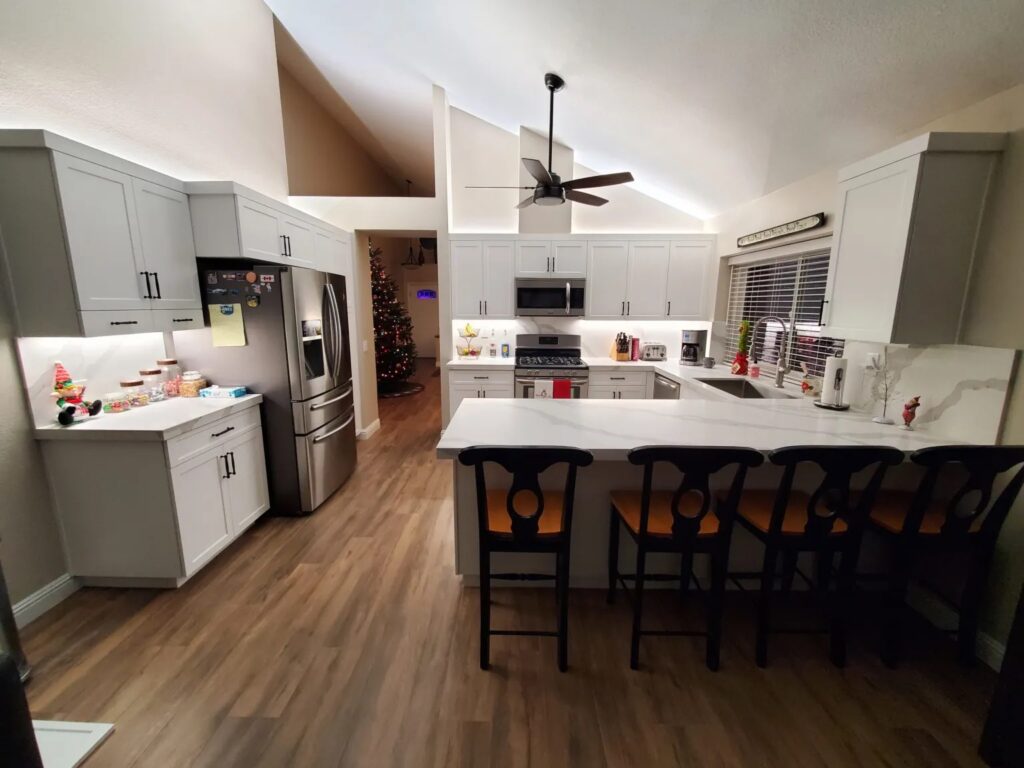
When you start looking at the real numbers behind a kitchen remodel, the budget can feel overwhelming. Counters, appliances, flooring, lighting—it adds up quickly. Somewhere in that process, most homeowners run into a tough question:
“Do I really need custom cabinets, or should I save money and go with prefab?”
On paper, pre-manufactured cabinets (also called pre-made, pre-fab, or semi-custom cabinets) often look like the smarter financial choice. They’re cheaper up front and easy to order. But there’s more to the story.
If you plan to live in your home for a while—or you simply care about long-term quality—it’s worth understanding exactly what you’re paying for with custom cabinets versus prefab.
What You’re Really Getting with Prefab Cabinets
Whether they’re marketed as pre-made, pre-fab, or semi-custom, most mass-produced cabinet lines are built with one main goal:
Hit a price point.
To keep prices low, something has to give. Usually, that means:
- Thinner plywood (or particleboard) made from lower-grade materials
- Inferior hinges and drawer glides
- Drawer boxes that look fine at first, but start showing weakness after a few years
Those “nice” dovetail drawer boxes? In many prefab lines, they only stay tight and solid for 2–5 years before the joints start separating. The hardware gets noisy, the drawers don’t glide like they used to, and the cabinets lose that solid, confident feel you expect from a kitchen you invested in.
Prefab can look good when it’s first installed. The real question is how it looks and feels five, ten, or fifteen years down the road.
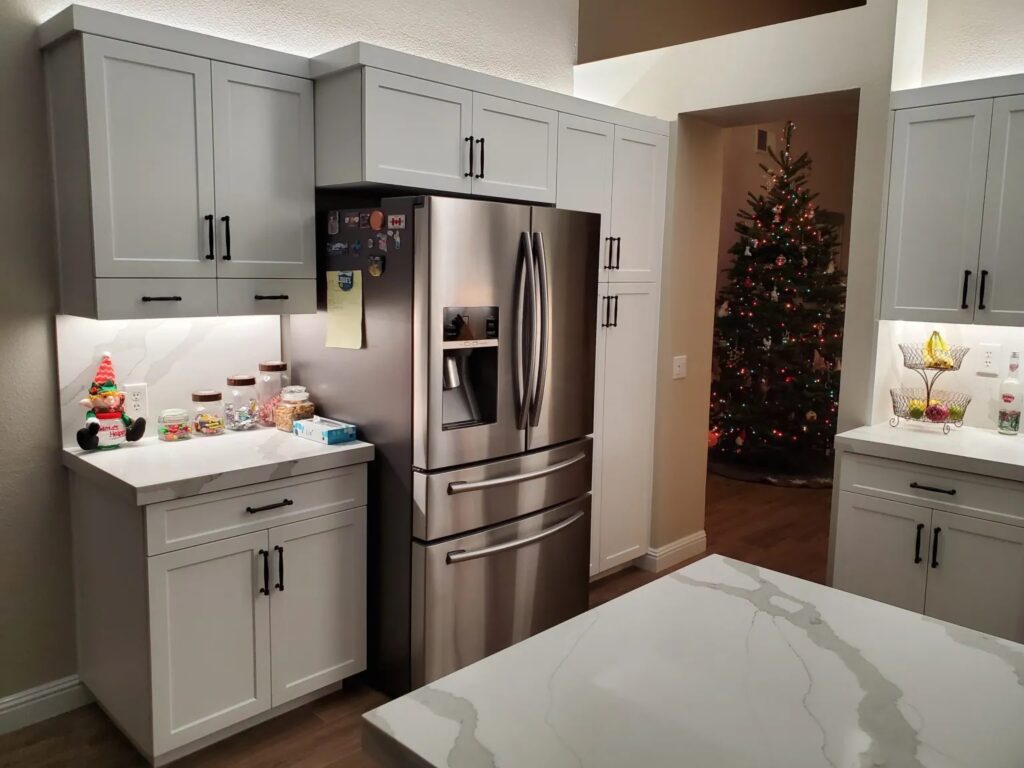
What You’re Paying For with Custom Cabinets
Custom cabinets do cost more upfront. There’s no way around that. But that higher price tag buys you something prefab simply can’t match:
Long-term quality, fit, and peace of mind.
At Caliber Woodcraft, custom cabinets are built around a different set of priorities:
1. Better Materials
- ¾” domestic plywood for cabinet boxes
- Locally sourced doors and drawer fronts from a family-owned shop
- Local drawer box suppliers using solid construction methods
You’re not dealing with flimsy import boxes. You’re getting solid, reliable materials designed to hold up to real life.

2. Top-of-the-Line Hardware
Hardware is where you feel quality every single day.
We use high-quality, Italian-made hardware with a lifetime warranty, including:
- Soft-close hinges
- Soft-close undermount drawer glides
That means drawers that keep gliding smoothly and doors that keep closing gently year after year.
3. Local Craftsmanship
Instead of cabinets and components being shipped halfway around the world, much of the work is done locally:
- Doors and drawer fronts: built locally by a family-owned business
- Drawers: sourced locally
- Finish: sprayed locally, with attention to detail
You’re investing in cabinetry that’s built with care—not just pushed down a factory line.
Custom Means Truly Custom (Not Just a Few Extra Options)
“Semi-custom” lines often market themselves as flexible, but they still work in 3” increments and rely heavily on filler pieces to make things fit.
Custom cabinetry works differently.
- No forced 3” increments
- No giant fillers just to eat up space
- Cabinets are built to your exact dimensions
That gives you:
- Cleaner lines and better proportions
- More usable storage
- Fewer awkward gaps and dead zones
Inside the cabinets, we can design around the way you actually live:
- Roll-out shelves
- Waste and recycling systems
- Lazy Susans and blind corner solutions
- Utility and spice pull-outs
- Tall storage for brooms or pantry items
- Under-cabinet and interior lighting integrations
Instead of forcing your life into someone else’s cabinet sizes, the cabinets are built around your home and your routines.
Short-Term Savings vs. Long-Term Value
Prefab cabinets can make sense if:
- You’re doing a very quick flip
- You need a short-term solution
- You’re working with a very tight budget and don’t mind replacing things down the road
But if you:
- Plan to stay in your home
- Cook regularly
- Care about the details
- Want your investment to last
then custom cabinets start to look a lot less like a “luxury” and a lot more like smart long-term value.
With custom cabinets, you’re investing in:
- Stronger materials
- Better hardware
- More storage
- A cleaner fit
- A kitchen that still feels solid and functional many years from now
Ready to Talk About Custom Cabinets?
If you’re on the fence between prefab and custom, it can really help to see and feel the difference in person—and to walk through layout options for your specific kitchen.
Caliber Woodcraft designs and builds custom cabinetry for:
- Kitchens
- Bathrooms
- Built-ins and media walls
- Laundry rooms and utility spaces
📞 Call (949) 300-9608 to set up a free consultation and explore what custom cabinetry could look like in your home. We’ll talk through layout, materials, budget, and help you decide whether custom is the right fit for your project.
Frequently Asked Questions About Custom vs. Prefab Cabinets
1. Are custom cabinets always more expensive than prefab?
Upfront, yes—custom cabinets usually cost more. But they often last longer, function better, and fit your space more efficiently, which can make them a better value over time, especially if you plan to stay in your home.
2. How long do prefab cabinets typically last?
It depends on the brand and use, but many prefab drawer boxes and hardware systems start showing wear within 2–5 years—especially the dovetail drawers and lower-grade glides. Custom cabinetry built with quality materials and hardware is designed for significantly longer service life.
3. Can custom cabinets help me get more storage than prefab?
Yes. Because custom cabinets are built to your exact dimensions, you don’t lose space to oversized fillers or awkward gaps. Interior accessories like roll-outs, spice pull-outs, and waste systems also help you use every inch more effectively.
4. Is custom cabinetry only for large, high-end kitchens?
Not at all. Custom cabinets can be especially powerful in smaller or tricky spaces, where every inch counts. Tight corners, odd walls, and unique layouts are where custom really shines.
5. What if I don’t know exactly what I want yet?
That’s completely normal. A consultation is a great place to start. We’ll talk about how you use your kitchen, what frustrates you now, what you like visually, and explore options—from door styles and materials to storage and lighting.